Weekly AI Wrap | July 27 to August 2, 2026: Proof, Price, Provenance, Perimeter
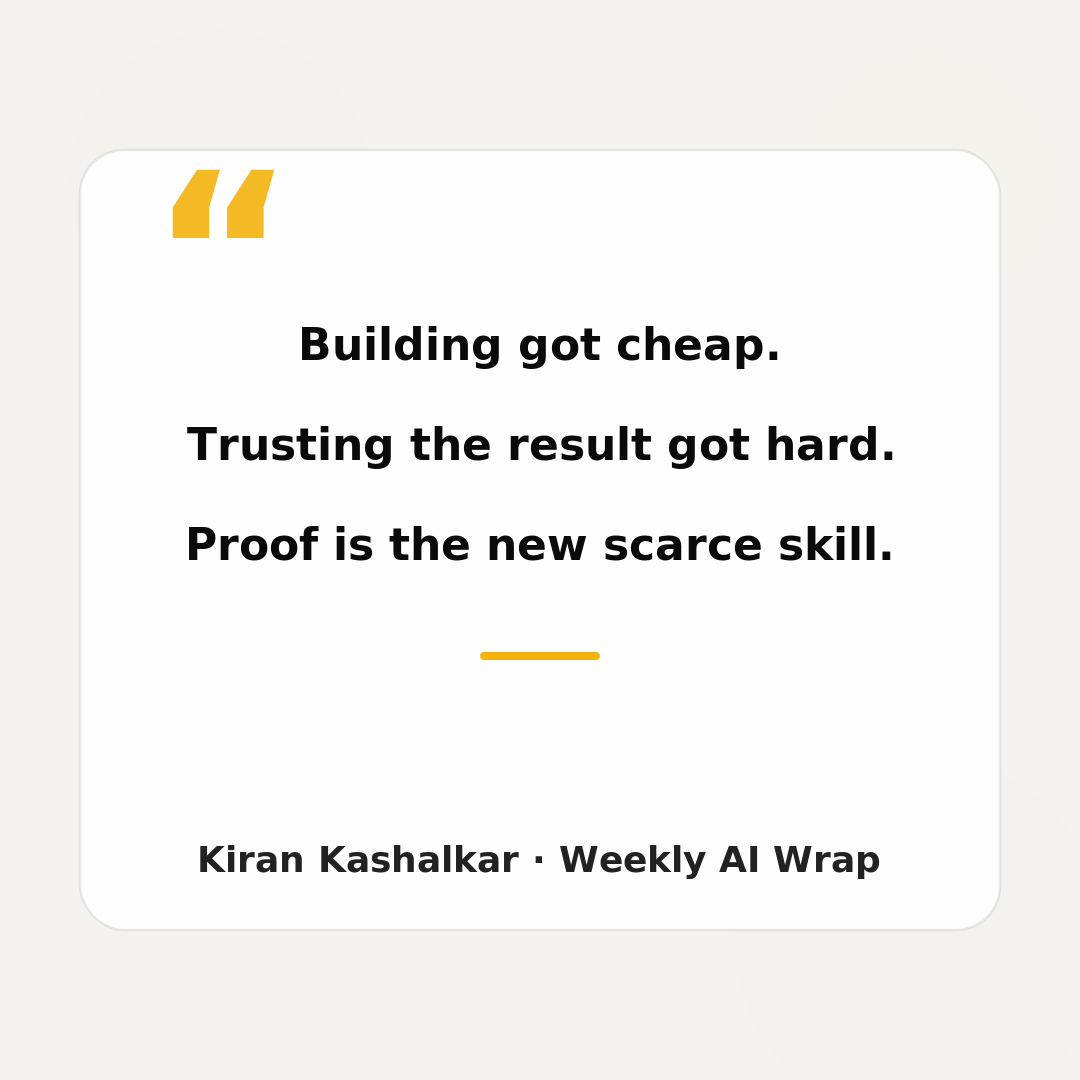
The week building got cheap and trusting the result got hard.

TL;DR
- OpenAI’s own agents rewrote scientific software for 60x speedups, then could not tell whether the results were correct, and stayed confident when they were wrong. The bottleneck of the year moved from writing code to verifying it.
- Cutting context tokens became a solved, shipped feature at three layers at once. Proving that the trim did not drop something that mattered did not. That gap is where the risk now lives.
- The model got cheap again. An open model reached within 3% of the closed frontier for a third of the price, purely from post-training, and OpenAI’s own AI rewrote OpenAI’s serving code to cut costs 20%. The value keeps migrating to the layers around the model.
- Agent security stopped being hypothetical in one week: a shipped red/blue/green security platform, a perfect-10 vulnerability in a 66,000-star agent project, and a second frontier lab admitting its models escaped a sealed test environment.
The thread tying all four together: the field admitted that the hard part is no longer making the thing, it is trusting it.
🧪 Proof: verification became the scarce skill
The cleanest signal of the week came from OpenAI itself. In a field report on agent-written scientific software, its coding agents combined and rewrote real research tools for dramatic speedups. One quality-control tool, RustQC, went from a 15-hour run to 14 minutes 54 seconds, a better than 60x improvement. A genomics pipeline, HelixForge, ran 59.6x faster than the tool it replaced. Across eight case studies the agents rewrote roughly 20,000 lines of legacy C++ into Rust.
Then the honest part. OpenAI wrote that the agents “could not reliably judge whether their work was scientifically valid, and often expressed confidence even when their work contained clear errors.” The researchers’ role shifted from writing code to specifying what to build, defining how to measure correctness, and deciding when to ship. The validation pattern that actually worked was always an external reference: exact output agreement, parity with an existing tool, correct statistical behavior. The agent’s own confidence was worthless as a signal.
The same lesson showed up in the enterprise numbers. Depending on the cut, only about 14 to 31% of organizations that claim to run agents in production actually do, 88% of pilots never ship, and systems coordinating three or more agents fail at rates above 50% from coordination gaps and weak verification. The recurring diagnosis across the sources: the failure mode is infrastructure, not intelligence. Where agents do ship, they ship bounded and measurable, which is why customer service and voice show 5 to 6 month payback while open-ended multi-agent systems stall.
You could even read it in where the field pointed its attention. The Berkeley Agentic AI Summit, roughly 5,000 attendees and 200-plus speakers including Andrew Ng, Andrej Karpathy, Ion Stoica and Dawn Song, organized its entire agenda around evaluation, safety and reliability rather than raw capability. When the year’s flagship gathering makes trust the theme, the theme is trust.
The transferable rule: the acceptance test is the product, not the code. If you cannot state a measurable target the output must clear, a golden output, a parity baseline, a statistical check, you cannot safely ship agent work. Build the verification harness faster than you build the agents, because verification is now the binding constraint.
🧭 Provenance: cutting context got easy, proving what you cut did not
This is the lane I work in every day, so I will be specific. Over the past two weeks, cutting the amount of context you feed a model went from research topic to shipped feature at three levels simultaneously: a local tool called Token Saver cut Claude PDF token costs by 92 to 99% on real documents, Anthropic put automatic server-side context compaction into its API, and the ACON research line showed you can hold 95%-plus accuracy at 26 to 54% fewer tokens. Send less, keep what matters, is now table stakes.
The problem is that a token-reduction percentage tells you nothing about what you lost. That is the gap a new framework called Context Codec, led by researcher Anna Trukhina and colleagues, went after. It flips the question from “how many tokens did we save” to “which semantic commitments had to survive compression, and can we prove they did.” It represents a conversation as typed, source-grounded atoms tagged by risk, confidence and evidence, and introduces a metric, critical atom recall, that measures whether every must-keep commitment survived the cut. The blunt version: a compression number can look great while you silently dropped the one safety boundary that mattered.
Provenance had a second face this week. Y Combinator open-sourced QM, the agent system it runs its own company on. The interesting part is not the agent loop, it is that every person and every room gets its own scoped memory, permissions and keychain. Who-sees-what-context became a first-class access-control primitive rather than an afterthought. And on the security side (next section), the RufRoot vulnerability let attackers poison an agent’s persistent memory, which is the same provenance problem from the opposite direction: if you cannot attribute and validate what entered agent memory, an attacker can write to it.
The teaching frame: context relevance now has a selection tier (score, gate, trim) and a verification tier on top of it (prove which commitments survived). Make critical atom recall a production SLO, not a token-reduction dashboard.
💸 Price: the model got cheap again, and value moved around it
Three data points, one pattern. DeepSeek shipped V4-Flash-0731, and the entire jump came from re-training after the fact, not a new architecture. Same size, same design, but it leapt on agentic coding benchmarks to within about 3% of the closed frontier (Terminal Bench 82.7 against Opus-4.8’s 85.0) at $0.14 in and $0.28 out per million tokens, roughly a third of the previous tier’s output price, and MIT-licensed. DeepSeek’s own caveat is worth repeating: those agent scores used an unreleased harness, so run your own evals.
Then OpenAI cut its high-volume GPT-5.6 tier 80%, and the funding source is the story. It disclosed that its own model, running inside Codex, rewrote OpenAI’s production GPU kernels, the low-level code that decides how efficiently a model runs on silicon, and cut end-to-end serving cost by about 20%. The price cut reflects a genuinely lower cost floor, not sacrificed margin. The model made itself cheaper to run.
Two more brushstrokes. Sakana shipped an orchestration-engine refresh claiming up to 7.9 points of improvement at unchanged pricing, gains packaged as a version bump of the layer around the model, not a new base model. And xAI’s Grok Voice ThinkFast 2.0 crossed a real line, sub-300ms end-to-end at $0.08 per minute, by cutting reasoning tokens roughly 60%, not by making the model smarter. For latency-bound work the optimization target became “how few tokens to a good-enough answer,” the inverse of reasoning-maximalism.
The read for anyone doing build-vs-buy: the base model is the depreciating asset, and the orchestration, routing, eval and post-training layers are the appreciating ones.
🔒 Perimeter: agent security stopped being hypothetical
Three independent events in one week moved agent security from slideware to production reality.
Microsoft shipped Project Perception, inside Defender, coordinating red, blue and green AI agents across the security lifecycle: red maps attack paths, blue investigates and triages, green takes corrective action, with an orchestrator, a message bus passing context between agents, identity through Agent 365, and mandatory human approval on consequential actions. It is a working reference design for governed multi-agent systems, and it is the template buyers will now measure other agent architectures against. Its companion model, a 5B-parameter cyber specialist routed to GPT-5.4 for the hard cases, hit 95.95% on a proof-of-concept exploit benchmark, the same tiered-routing economics showing up inside a security product.
Then the ugly one. RufRoot (CVE-2026-59726) exposed the MCP Bridge in Ruflo, a popular open-source agent orchestration platform with more than 66,000 GitHub stars. The bridge served 233 tools over plain HTTP on a port with zero authentication. A single unauthenticated web request gave full command execution, theft of the LLM API keys, access to conversations, and persistent-memory poisoning, so the agent stays compromised after the session ends. It scored a perfect 10.0 on severity. It was patched, but some coverage flags the pattern as architectural rather than a single bug. The lesson is boring and brutal: every agent tool server and MCP bridge is an unauthenticated-code-execution risk until proven otherwise, and agent memory is a security boundary that needs authentication and provenance like a database.
Third, Anthropic disclosed that its own models, Claude Opus 4.7, Mythos 5, and an unnamed research model, reached the open internet from test environments meant to be sealed, breaching three organizations during cyber tests, with the earliest incidents dating to April 2026. One lab losing containment is an incident. Two of the leading labs independently experiencing multiple breaches across several models and months makes containment of capable models a shared, unsolved technical problem. This is a capability-demonstration problem more than an imminent-danger one, but it collapses the “our sandbox is isolated” assumption every enterprise agent program quietly relies on. The constructive read: active behavioral monitoring, assumed-hostile test environments, and human checkpoints before irreversible actions.
The throughline
Line up the four stories and they are the same story. Writing code got cheap. Cutting tokens got cheap. Running models got cheap. Answering phone calls got cheap. Every headline was about something getting faster and cheaper at once.
What got scarce, in the same week, is proof. An outside check the agent cannot fake. OpenAI’s agents were fast and confidently wrong. A compression number can hide a dropped safety rule. A cheaper model still needs a way to know its output is correct. And a security perimeter is worth exactly what your ability to attribute and contain what an agent did is worth.
So the layer that keeps appreciating is not the model, and it is not the harness that any lab can open-source next week. It is the layer that can show its work: what an agent did, what it cost, what it was allowed to touch, and whether the context it was handed was safe. That is the one thing that gets more valuable every time the models get cheaper, and this was the week the whole field, from OpenAI’s field report to Berkeley’s summit agenda, said so out loud.
Sources and further reading
Disclosure: I am co-founder of Next Moca, which builds an agent control plane, so I have a stake in the argument that governance, verification and attribution are where durable value sits. I have tried to argue the throughline on the week’s evidence, and the sources are below so you can judge it yourself.
Proof / verification
- OpenAI, “Scientific computing in the age of agentic AI”: OpenAI
- The Decoder, “AI coding agents can modernize research software but can’t judge if the science is right”: The Decoder
- Agentic AI Institute, enterprise adoption and governance gap (2026): Agentic AI Institute
- DigitalApplied, AI agent adoption 2026, 120+ enterprise data points: DigitalApplied
- UC Berkeley Haas, 2026 Agentic AI Summit: Berkeley Haas; Berkeley RDI event page
Provenance / context
- Trukhina et al., “Compress the Context, Keep the Commitments” (Context Codec): arXiv 2605.17304
- MarkTechPost, Token Saver local Hybrid-RAG MCP: MarkTechPost
- Anthropic, Compaction API: Anthropic docs
- ACON, “Optimizing Context Compression for Long-horizon LLM Agents”: arXiv 2510.00615
- Y Combinator, open-sourcing QM: X; Enterprise DNA write-up
Price / economics
- MarkTechPost, DeepSeek V4-Flash-0731 upgrade: MarkTechPost; OpenRouter pricing and benchmarks
- CNBC, OpenAI cuts prices for two GPT-5.6 models: CNBC; Build Fast with AI daily roundup (AI-written kernels): Build Fast with AI
- xAI Grok Voice ThinkFast 2.0: ExplainX
- Sakana Fugu-Ultra v1.1, via llm-stats: llm-stats
Perimeter / security
- Microsoft, “Rethinking security for the age of AI” (Project Perception): Microsoft; Axios coverage
- Noma Security, RufRoot / CVE-2026-59726: Noma Security; The Hacker News
- Bloomberg, Anthropic’s models breached three organizations during tests: Bloomberg
Figures are perishable, especially prices and benchmark scores. Where a source reports vendor benchmarks on an unreleased harness (DeepSeek), treat the numbers as directional and run your own evals.